With UAE’s heat reaching 45°C and 11+ UV radiation, nano ceramic window tint is the better choice compared to carbon ceramic window tints. Nano ceramic tint rejects more infrared heat and lowers the cabin heat by ~15-20°C. Carbon ceramic window tint is a budget-friendly option with limited heat rejection.
Window film for cars has become a necessity for UAE car owners. Long-term UV exposure can damage the car’s interior and upholstery and your skin. Nano-ceramic films use microscopic ceramic particles that block IR rays. Carbon window tinting excels compared to dyed window films.
In this blog, we cover a comparison of carbon and ceramic window tint, cost estimates, top brands, and legal aspects of window tinting films.
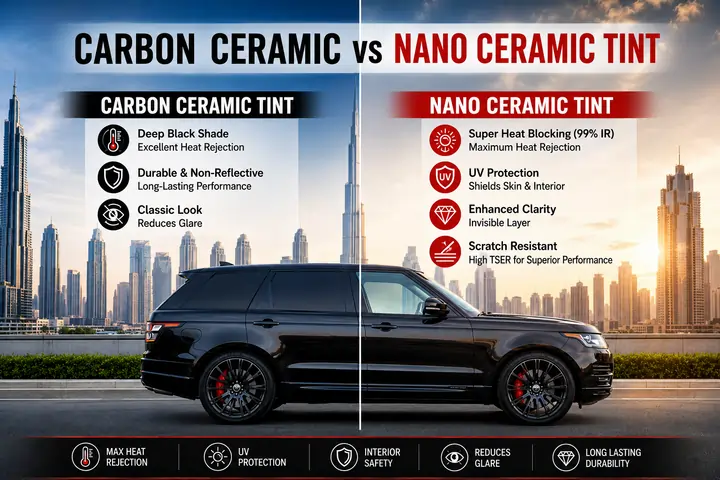
What’s the Difference Between Carbon Ceramic Tint and Nano Ceramic Tint?
Carbon ceramic window films are a look-and-budget upgrade. Think of it as a good premium. Meanwhile, ceramic window films offer the best performance. Let’s take a look at carbon ceramic vs nano ceramic tint.
|
Feature |
Carbon Ceramic Tint |
Nano Ceramic Tint |
|
Heat Rejection |
Good |
Excellent |
|
UV Protection |
Excellent |
Excellent |
|
Night Visibility |
Good |
Better |
|
Signal Interference |
None |
None |
|
Appearance |
Dark, premium finish |
Clear, premium finish |
|
Durability |
High |
Very High |
|
Price |
More affordable |
Premium |
|
Best For |
Budget-conscious buyers |
Maximum heat rejection and comfort |
What is Carbon Ceramic Window Tint?
Carbon ceramic window film for cars is a premium hybrid automotive film. It infuses carbon particles and ceramic nanoparticles into one material. This combination offers glare reduction and heat rejection. This window tint has color stability, and it does not interfere with vehicle electronics. They use zero metal particles.
What’s the Mechanism of Carbon Ceramic Tint?
Carbon window tinting blends two different technologies. This presents a strong alternative to dyed or metallized window films. It has a multi-layered polyester base featuring microscopic particles. They block the sun’s light.
The Layered Nano Structure
Carbon window films have microscopic layers stacked together.
|
Layer |
Function |
|
Scratch-Resistant Coating |
Protects the film from scratches |
|
Carbon Layer |
It absorbs visible light and reduces glare |
|
Ceramic Nanoparticle Layer |
Blocks IR heat with nano-ceramic particles for superior heat rejection (indium tin oxide or antimony tin oxide) |
|
UV-Blocking Adhesive |
Bonds the film to the glass |
What is Nano Ceramic Window Tint?
Ceramic window films are automotive tint films that use invisible, microscopic ceramic particles. They are made to block the heat without darkening the glass’s appearance. The nano refers to the size of ceramic particles used in the films. One particle is in nanometers, which is smaller than a wavelength of visible light. It means that they do not scatter the light and the film remains clear.
Manipulating Matter: The Power of Nanometers
A human hair strand is around 80,000 nanometers wide. And a ceramic particle is one-billionth of a meter. The small particles are made of inorganic materials. They filter the light selectively and absorb the heat. With advanced atomic stability, ceramic window tints do not fade over time like dyed window tinting. Ceramic window tints treat each wavelength differently:
|
Radiation Type |
Wavelength Range |
How Nano Ceramic Tint Responds |
|
Ultraviolet (UV) |
100-400 nm |
UV rays are blocked to protect occupants and prevent interior fading |
|
Visible Light (VL) |
380-740 nm |
Allows visible light to pass through for clear visibility |
|
Infrared (IR) |
700-2,500 nm |
Absorbs infrared heat, helps keep the cabin cooler |
Carbon Ceramic vs Nano Ceramic Tint: Which One Has Better High Rejection?
Nano ceramic window tints offer better heat rejection than carbon window tints. Ceramic films reject the highest possible amount of solar heat.
|
Feature |
Carbon Ceramic Tint |
Nano Ceramic Tint |
|
Infrared Heat Rejection (IRR) |
Blocks 40%-60% of infrared heat |
Blocks up to 90%-98% of infrared heat |
|
Total Solar Energy Rejected (TSER) |
40%-55% |
55%-70% |
|
Heat Management |
Absorbs heat, the glass becomes hotter |
Absorbs and reflects heat, reduces cabin heat buildup |
|
Performance in Light Shades |
Darker shades needed for better heat rejection |
Excellent heat rejection even in lighter shades |
Why Nano Ceramic Window Tints Have Better Heat Rejection?
Let’s understand step-by-step:
Dual Action Heat Blocking
Carbon window tints absorb the sunlight and eventually, they radiate some of it into your car. Ceramic window films do a dual job. They not only absorb but also reflect IR rays.
High-Density Coverage of Car Window Films
Nnao ceramic window films are packed with numerous nano ceramic particles. This forms a tight shield on your car’s glass compared to carbon window tinting.
Better Visible Light Flexibility
For high heat rejection in carbon tints, you need to choose a darker shade of window film. But, in ceramic window films, you can choose a lighter shade and yet still get excellent heat rejection.
What is the Difference in VLT Between Carbon Ceramic & Nano Ceramic Window Films
Before diving into both films’ VLTs, let’s understand what this means.
What is a VLT in Window Tinting?
VLT, the abbreviation of Visual Light Transmission, means how much light percentage passes through window film. Each window tint comes in different VLTs. For example, if you applied a 50% VLT window film, it means that 50% light is passing through the film inside the cabin. 20% means only 20% of the light is passing.
Carbon ceramic window tints and nano ceramic window films are manufactured within the same VLT standards. But the difference lies in how VLT interacts with heat rejection in both cases.
VLT in Nano Ceramic Window Tint
Here you can decouple VLt from heat rejection. Ceramic window films for cars are available in high VLTs: 70% to 80%. They are visually clear and still reject a high rate of IR rays.
VLT in Carbon Ceramic Window Films
You won’t find light VLT options because, generally, carbon tints have to be dark for heat rejection. If you want light VLT in carbon ceramic window films, you will have to compromise on heat reduction.
Which Car Window Film Lasts Longer in UAE’s Conditions
Nano ceramic window films last longer in UAE’s heat. The index structural cabin heat spikes to 65°C. A cheap or low-quality film can degrade and fade faster in these conditions. Nano ceramic window films are built on highly stable inorganic compounds. It does not absorb very much IR radiation but reflect them. It resists the thermal stress without failure.
|
Feature |
Carbon Ceramic Tint |
Nano Ceramic Tint |
|
Lifespan |
5-7 years |
Around 10 years /Lifetime* |
|
Warranty |
5 years |
Approx. 10 years /Lifetime* |
|
Color Stability |
Fade-resistant but can show fading signs in prolonged exposure |
Superior fade resistance |
NOTE: Warranties differ based on brand and film type.
Carbon Ceramic vs Nano Ceramic Tint for Different Drivers
|
Driver Type |
Recommended Film |
|
Daily commuters |
Nano ceramic window films |
|
Luxury vehicles |
Nano ceramic window films |
|
Family SUVs |
Nano ceramic window films |
|
Ride-hailing vehicles |
Carbon ceramic window films |
|
Performance cars |
Nano ceramic window films |
|
Budget-conscious owners |
Carbon ceramic window films |
What is the Cost of Carbon Ceramic & Nano Ceramic Window Films
Carbon ceramic window films are a budget-friendly option for UAE car owners. Nano ceramic window tints are in a premium price bracket. While ceramic window films are costly, the exact window tinting price in UAE depends on your car’s size, film quality, and installer.
Here are the cost estimates for window tinting:
|
Window Film Type |
Typical Price (UAE) |
|
Carbon Ceramic Tint |
AED 250-399 |
|
Nano Ceramic Tint |
AED 499-799 |
Is Window Tinting Legal in UAE?
UAE follows stringent laws when it comes to aftermarket automotive window film. The Roads and Transport Authority (RTA) has enforced legal limits on car window tints in UAE. Non-compliance leads to substantial punishments and fines.
The permitted limit of window films in UAE is:
- Side and rear windows: Maximum of 50% VLT window tint
- Front windshield: Not permitted (a small 15-centimeter strip at the very top is allowed)
Are There Any Exceptions and Exemptions in UAE Window Tint Rules?
Yes, There are:
-
Trucks, taxis, and delivery vans can not get window tints in UAE.
-
Individuals with eye or skin problems can get low VLT window films with a medical certificate.
-
The limits don’t apply to VIP permits.
Expert Tip:
One of our detailing experts, Mustafa, once told us a story about a customer who wanted 50% window tints for their Toyota RAV4. The rear passenger and tailgate windows already had 30% tint from the factory. He thought he’d be staying under the legal border. But, Mustafa understood. And he explained to the client that as per the UAE’s window tinting laws, any aftermarket film must not drop the combined VLT. What does it mean?
-
Already tinted: 30%
-
Customer asked: 50% tint
-
Total: 80%
The combined tint exceeds the 50% legal limit of UAE window tints. UAE's federal traffic laws dictate specific limits, and it doesn’t matter if it's pre-installed or aftermarket auto window film. Mustafa measured the tint in front of them and advised them to get a compliant car window film.
Is it Worth Getting Nano Ceramic Tint Over Carbon Ceramic Window Film?
Yes. Nano ceramic window tints are worth the extra cost if you want excellent heat rejection and clear night driving. Both films do not block radio waves and disturb the signal. However, they use different technologies, which result in different levels of heat reduction. Nano ceramic window tints will not give that low-angle haze and will remain optically clear. The better heat rejection ultimately unburdens your air conditioning. Your car cools down much faster.
Carbon Ceramic or Nano Ceramic: Which One Should You Choose?
Choose nano ceramic window films if your goal is heat rejection and crystal-clear visibility. Carbon ceramic films are the best fit for those who want an easy-on-the-pocket option.
Choose Carbon Ceramic Tint If:
-
You're on a budget
-
Dark, matte finish is your priority
-
Privacy is more important to you
-
You're upgrading from dyed tint
Choose Nano Ceramic Tint If:
-
You want maximum heat rejection
-
Extreme UAE heat bothers you
-
You are a luxury car owner
-
You regularly do night driving
-
You wanna invest to protect your car’s interiors
Popular Carbon and Nano Ceramic Window Tint Brands in UAE
You will find multiple window tint options in the market. Here we have shortlisted some of the best ones. Ceramic window films are the best for Indian car owners.
The best brands for window tinting are:
|
Window Tints Brand |
Qualities |
|
Ultraguard |
Wide range of lab-tested films, 99% UV and 96% IR rejection, multilayer technology, scratch-resistant |
|
3M |
99% UV and 98% IR rejection, |
|
V-KOOL |
99% UV rejection, 5.3°C to 9.6°C difference |
|
XPEL |
99% UV and 98% IR rejection |
Why Professional Window Tint Installation Matters
DIY car window tints can seem easy at first but they also have a few downsides. Surface prep is important before applying automotive tints. A professional car tinting service cleans and degreases the interior glass first. This ensures a bubble-free application. A professional studio also provides a performance guarantee and a warranty on the product. Warranty is not applicable when you DIY a window tint. That's why we suggest you choose a reputable installer.
Why Choose us for Window Tinting in UAE
Backed by the 39-year legacy of the Manmachine Group, Ultraguard offers high-quality carbon ceramic and nano ceramic window films. Our sputtering technology utilizes 11 to 15-layer construction for maximum protection. Our window tint lineup offers 96% IR rejection.
Here are the advantages of Ultraguard window tinting:
|
Specification |
Ultraguard Body Ice Window Films |
|
Infrared Rejection (IRR) |
Up to 95% |
|
UV Rejection (UVR) |
99% |
|
Warranty |
10 Years |
|
Film Thickness |
2 mil |
|
Scratch Resistance |
>2H Hardness |
|
Visible Light Transmission (VLT) Options |
5%, 35%, 55%, 75% |
|
Warranties |
5 years to lifetime warranty |
Why TSER Matters in Window Films?
TSER (Total Solar Energy Rejected) measures how much total solar heat a window film blocks. It is the best indicator of real-world cooling performance. A higher TSER means a higher heat rejection.
Our Window Films’ TSER (Total Solar Energy Rejection)
|
VLT (%) |
TSER (%) |
|
5% |
75% |
|
35% |
61% |
|
55% |
52% |
|
75% |
42% |
Conclusion
Car carbon ceramic window tint vs nano ceramic window tints boils down to your priority. If you prefer heat rejection over privacy, nano ceramic window films are a go-to option. But if you want enhanced privacy more than heat reduction, choose carbon ceramic window tinting. Top window tint brands for cars offer legal tint in the UAE. Dubai’s heat doesn’t do subtle. So you should choose a car window tint that can last a long time.
Carbon Ceramic vs Nano Ceramic Tint - FAQ's
Q1. What tint is legal in the UAE?
UAE legal tint limit is 50% for side and rear windows and no tints for the front windshield. If found non-compliant, a fine of AED 1500 will be imposed.
Q2. What are the disadvantages of nano ceramic tint?
The disadvantage of nano ceramic tints is that it comes in a premium price bracket. Because it is made with advanced nano ceramic technology. It is non-conductive and non-metallic.
Q3. Is nano ceramic tint better than carbon?
Yes, Nano ceramic window tints are better than carbon window tints in terms of heat rejection and optical clarity. Ceramic window tints are preferred in UAE.
Q4. Is it worth getting nano ceramic tint?
Yes, Ceramic tints work very well in Dubai’s heat. They reflect and absorb IR rays that result in significantly cooler car cabins. They can reject 99% UV rays and 96% IR rays.
Q5. What are the best tools for DIY window tinting?
The best tools for DIY window tinting are a heat gun, snap-off utility knives, hard cards, and a squeegee.
