Marine PPF is a sacrificial protective coat applied to vulnerable painted or gelcoat surfaces. Boats and yachts in the UAE face constant damage from saltwater, sand, dock rash, scratches, and UV exposure. Marine Protection Film provides an extra layer of protection that fights off these hazards while keeping the gelcoat safe underneath. Marine Paint Protection Film is made of TPU (thermoplastic polyurethane) and is installed on the exterior hull, interior surfaces, decks, and walkways.
In this guide, we discuss Boat PPF, cost, what it protects against, types, benefits, maintenance, and PPF vs. alternatives.
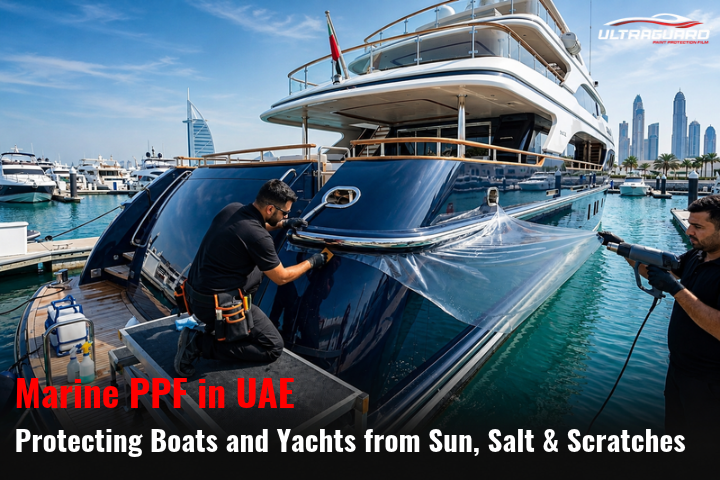
What Is Marine PPF and How Does It Work?
Marine PPF, or marine paint protection film, is a transparent and durable protective film applied to boats and yachts to protect painted surfaces, gelcoat, and high-wear areas from physical and environmental damage. Yacht Paint Protection Film is somewhat similar to automotive PPF. It is designed for prolonged exposure to sunlight, saltwater, humidity, and marine use. Brands like Ultraguard offer marine protection film made with PCDL technology, also called PCU TPU. The hydrophobic, self-healing top coat makes it compatible for the long run.
What Materials Are Used in Marine PPF?
Market breakdown:
-
Polyurethane-based Marine Protection Film: 44.47% (Best marine PPF)
-
PVC-based PPF for Boats: 30.22%
-
Ceramic/hybrid Marine Film: 25.31%
Marine PPF products are made of many raw materials. The largest segment is TPU Marine PPF.
What Does Marine PPF Protect Against?
TPU Marine PPF safeguards the paint while reducing:
-
Dock rash and minor impact marks.
-
Marine PPF scratch repair from fenders, ropes, equipment, and fishing gear.
-
Saltwater stains and surface contamination.
-
UV-related fading and oxidation.
-
Wear due to repeated cleaning and maintenance.
-
Loss of gloss on painted or gelcoat surfaces
Where is PPF for Marine Applied?
Marine protection film isn’t for every corner coverage. It is applied selectively on the hot areas where damage is more likely to happen. Application areas include:
-
Hull sides and bow sections
-
Transoms and swim platforms
-
Docking and fender-contact zones
-
Painted superstructures
-
Glossy outboard-engine covers
-
Helm consoles and selected interior panels
-
Other above-waterline high-contact surfaces
Why Are Boat and Yacht Owners Choosing Marine PPF?
Boat and yacht owners are actively choosing marine PPF to save themselves from costly repairs that can occur without boat paint protection. It physically absorbs impacts and prevents expensive damage. Waxes and marine ceramic coatings cannot prevent those.
The data tells the full story. Marine protection film is witnessing steady growth. According to market estimates from PW Consulting Chemical & Energy Research Center, the global marine PPF market was valued at USD 485.45 million in 2025.
|
Market Indicator |
Data |
|
Market value, 2020 |
USD 388.5 million |
|
Market value, 2025 |
USD 485.45 million |
|
Projected market value, 2032 |
USD 722.74 million |
|
CAGR |
5.85% |
|
Growth (2020–2025) |
~25% |
|
Expected growth |
~49% |
Who Is Buying Marine Paint Protection Film?
Marine protection film is steadily expanding from luxury boats to commercial fleets:
|
Vessel Segment |
Market Share |
|
Luxury yachts & recreational boats |
49.89% |
|
Commercial vessels |
35.27% |
|
Military & government ships |
14.84% |
What Are the Benefits of Marine PPF for Boats and Yachts?
Dubai, Abu Dhabi, and other UAE coastal waters make Marine PPF film especially useful. Here, UV, heat, humidity, salt spray, dust, and marina contact speed up surface deterioration.
Reduces UV fading and oxidation:
Your boat’s gelcoat and painted surfaces stay safe from the UAE’s year-round sunlight, which slows chalking, fading, and loss of gloss.
Protects against dock rash:
Hull sides, bow sections, transoms and swim platforms are protected from scratches. Pontoons, fenders, ropes, trailers, and marina structures can constantly cause scratches.
Limits salt and mineral staining:
Creates a sacrificial barrier from salt deposits and water spots that can bake in hot surfaces.
Handles Gulf heat and humidity:
Marine PPF films are suitable for exposure to high temperatures, humidity, and saltwater–not just ordinary automotive conditions.
Polishing frequency:
By protecting the original finish, PPF can reduce polishing. It preserves gelcoat thickness.
Appearance and resale value:
Minimum cosmetic refurbishment requirements if you’re keeping the hull and superstructure glossy with TPU marine PPF.
Protects high-contact areas:
It is particularly valuable on expensive or frequently touched areas: Helm consoles, engine covers, boarding points, and fishing zones.
Dubai's Growing Marine Ecosystem Needs Marine Paint Protection Film
Dubai’s expanding marine sector can leverage marine PPF and yacht protection services. According to the Dubai Maritime Authority (DMA), as reported by WAM and maritime trade sources:
|
Marine Sector Indicator |
Figure |
|
Registered marine craft |
8,415 |
|
Maritime companies |
14,000+ |
|
Vessels registered in Dubai in 2024 |
7,738 |
|
Growth in vessel registrations |
14.4% |
|
DMA-managed berths in H1 2025 |
4,190 |
|
Foreign yacht arrivals in H1 2025 |
+149% |
|
New marine licences |
+19% |
|
Selected marine-operation permits |
25.6% |
What Type of Marine PPF Is Best for Boats and Yachts?
A traditional thermoplastic polyurethane marine protection film is the industry standard but given the demanding UAE conditions, this cannot be suitable for a longer period. That’s why Ultraguard has come up with an advanced PCU PPF for marine to make marine paint protection more durable. An automotive PPF uses polycaprolactone-based TPU, but Ultraguard has tied up with Lubrizol to offer polycarbonate-based TPU. Lubrizol is one of the pioneers of polymer chemistry, especially TPU. It also offers PCDL chemistry in its flagship product line. And the same chemistry has been used in Ultraguard marine protection film in UAE. PCDL TPU marine PPF is the best marine PPF in the GCC. PCU PPF wins in:
-
high hydrolytic stability
-
thermal stability
-
chemical resistance and
-
abrasion performance
What Trade-Offs Come With Marine PPF?
Marine PPF is still garnering traction in UAE. There are a few trade-offs for marine PPF products:
-
Installation charges are higher than automotive PPF due to the larger surface and complex curves.
-
Marine protection film installation demands skills with experience. Only a few studios have that.
-
Boat Marine PPF can be the best, but you need to choose the best film; otherwise, it will just be an expensive cover.
-
Boat Paint Protection Film can make the upkeep simple, but you cannot afford to ignore the maintenance. It can eliminate damage, but you still need to wash, remove, and decontaminate.
Marine PPF vs Vinyl Wrap: Which Makes More Sense?
Marine Paint Protection Film makes more sense than vinyl wraps in terms of physical protection. Vinyl wrap can be an option if your goal is to change the aesthetics. But with marine PPF, you can get aesthetics and paint protection both.
|
Factor |
Marine PPF |
Marine vinyl wrap |
|
Primary purpose |
Protects gelcoat and paint |
Changes colour or adds graphics |
|
Material |
TPU-based protective film |
PVC/vinyl film |
|
Scratch and impact protection |
Stronger |
No |
|
Dock-rash protection |
Better for high-contact areas |
Moderate |
|
UV and salt resistance |
High |
Varies by product |
|
Appearance |
Clear, gloss or matte |
Unlimited colours and designs |
|
Self-healing |
Available |
No |
|
Best application |
Bow, hull sides, transom, swim platform and fender zones |
Full hull colour change, branding and styling |
|
Warranty |
7-10 years |
around 2–7 years |
|
Cost |
Higher |
Usually lower |
|
Repair strategy |
Replace damaged sections |
Patch or replace visible sections |
Marine PPF vs Marine Coating: Which Is Better?
Marine PPF for Yachts adds a protective layer on gelcoat, whereas marine-grade coating is a chemical treatment that protects from UV, salt, staining and gives easier maintenance. Best option is to choose both on different areas.
|
Factor |
Marine PPF |
Marine ceramic coating |
|
Main function |
Absorbs scratches, scuffs, and minor impacts |
Protects against UV, oxidation, salt, and staining |
|
Dock-rash protection |
Excellent |
No |
|
Scratch and chip resistance |
Strong |
No |
|
Gloss enhancement |
Good |
Excellent |
|
Water and dirt repellency |
Good, if hydrophobic topcoat |
Excellent |
|
Maintenance reduction |
Moderate |
High |
|
Coverage |
Usually selected for high-impact areas |
Can cover large surface areas |
How Much Does Marine PPF Cost?
Marine protection film cost depends on boat size, coverage, film type, hull complexity, surface preparation, and existing gelcoat condition.
|
Coverage |
Approx Pricing |
|
Small high-contact area |
AED 3,000-7,000 |
|
Bow or docking-zone protection |
AED 7,000-15,000 |
|
Transom and swim platform |
AED 5,000-12,000 |
|
Partial hull package |
AED 15,000-35,000 |
|
Full coverage on a small boat |
AED 25,000-50,000 |
|
Full yacht coverage |
AED 50,000–150,000+ |
NOTE: Marine PPF does not have a single fixed price because installation cost depends heavily on the vessel's size.
Is Marine PPF Actually Worth It for Boats?
PPF for boats and yachts is worth it, but it depends on how you use your vessel and where you apply it. High-value yachts and performance speedboats can benefit most from marine protection films. Waxes and marine ceramic coatings cannot offer that level of protection.
How to Choose the Best Marine PPF for Your Boat
Follow this expert-curated checklist to choose the best marine PPF for boat:
-
TPU film: The most common marine choice, and built to flex.
-
Hydrophobic, self-healing topcoat: Sheds water and heals light swirls.
-
UV and Salt resistance: Gulf sun and sea spray wear down weak films.
-
Curve-ready flexibility: Hulls aren't flat. The film shouldn't fight the shape.
-
Marine-experienced installer: Car work doesn't equal boat work.
-
Clear warranty terms: Know what's covered on water and for how long.
-
Aftercare guidance: Ask how to wash it and what to avoid.
Conclusion: Is Marine PPF Right for Your Boat or Yacht?
Marine PPF = Physical Protection + Appearance Preservation + Targeted rotection against everyday surface damage
Marine paint protection film can be best for those owners who want the best value protection for their priced possession. UAE conditions make surface protection an important consideration. But choosing a marine PPF film is just 50% of the work. Installation matters as much as the PPF for boat itself. Choose an experienced studio to install marine protection film, such as Detail Empire. If you are worried about marine PPF cost in Dubai, you can choose partial coverage instead of going for a full wrap.
FAQ's - Marine Protection Film
Q1. How much does it cost to PPF a boat?
Marine PPF cost depends on your boat's size, area you cover and the film you pick. Marine PPF for Boats on just the bow costs far less than a full hull. Marine PPF for Yachts costs more because of the big surface. Ask for a written quote based on your boat. A good installer will explain every line.
Q2. What are the best marine PPF products for boat protection?
Look for TPU Marine PPF. It's flexible, tough and sits well on curved hulls. Pick a Boat Paint Protection Film that has self heal coat and also ceramic infused like Ultraguard. It resists UV and salt with up to lifetime warranty. The best Marine Protection Film is the one your installer trusts and has used on real boats. Ask to see their work.
Q3. What's the best marine PPF for a center console boat?
Center console boats take hits at the bow, hull sides and gunwales. Start there. Marine PPF for boats like these protects against dock rash, gear, and rope wear. PPF for Boats on the leaning posts and console edges helps too. Choose a flexible TPU film for those curves. Now add a ceramic coating on the hull.
Q4. How to stop gelcoat from fading on my boat?
Sun and salt oxidize gelcoat. Your coat gets chalky and looks faded. Marine Paint Protection Film adds a UV-resistant barrier on the surface. To slow down the fading, wash your boat with fresh water after every trip. Apply wax on exposed areas. Keep the boat covered or in shade when you can.
Q5. Help me choose marine PPF for a saltwater fishing boat
Saltwater is tough on boats. Choose TPU Marine PPF with a strong salt and UV barrier. It can be best applied on the bow, hull sides, transom, and rod-handling zones. Fishing boats face more damage from gear, anchors, and docks. A hydrophobic topcoat makes salt baking hard. Choose an installer who has done Boat PPF or Yacht PPF on vessels. So you can get the best finish.
Q6. Compare clear marine PPF and colored boat wraps
Clear marine PPF protects your gloss while keeping the original color. It absorbs impact, and self-healing films fix light marks. Colored wraps change the look. They are made for style and lack serious protection. If you want paint protection, choose Yacht Paint Protection Film. If you are craving a new color, pick a wrap.
Q7. What properties make marine PPF effective for boats?
Good marine PPF is tough, flexible, and clear. TPU Marine PPF stretches over curved hulls without cracking. UV and salt resistance are important too. A hydrophobic, self-healing topcoat helps it further. Strong adhesive keeps edges sealed in wet conditions. Quality PPF for Yachts should also stop yellowing. Together, marine PPF keeps your vessel safe.
