PPF installation process is as decisive as the TPU paint protection film itself. Even the best TPU can peel, trap dust, or show ugly edge lines if the installation falls short. paint protection film application process makes half the equation.
Paint protection film installation process demands: Meticulous surface preparation. Precision-cut templates for an exact panel fit. Careful bubble-free application. And most importantly, full curing time. Because rushing can make it all go south. In this blog, we break down the complete PPF installation process step by step, PPF installation time, UAE price, and whether you can DIY it or not.
What is the Process of PPF Installation?
Paint protection film application is a step-by-step process to apply the film to the painted surface of your Car. It is a precise and labor-intensive job that comprises multiple steps for a seamless installation.
-
Prepare the paint
-
Positioning the film accurately
-
Remove air and moisture
-
Wrap edges where possible
-
Allow the adhesive to cure
Our PPF expert, Mustafa, explains, think of PPF installation as you apply a screen protector to a smartphone. But on a much larger and more complex surface. Now stretch that across curves, body lines, panel gaps, and sharp edges. One speck of dust or an inch of misalignment throws off the whole PPF. That’s why installers work in dedicated spaces. A controlled, contamination-free space, no room for guesswork. A good PPF install isn’t just film stuck to the panel. But the film staying invisible, bubble-free, and built to last.
Step-by-Step PPF Installation Process
Premium studios like Detail Empire follow a standard procedure for the paint protection film installation process. Let’s decode each step:
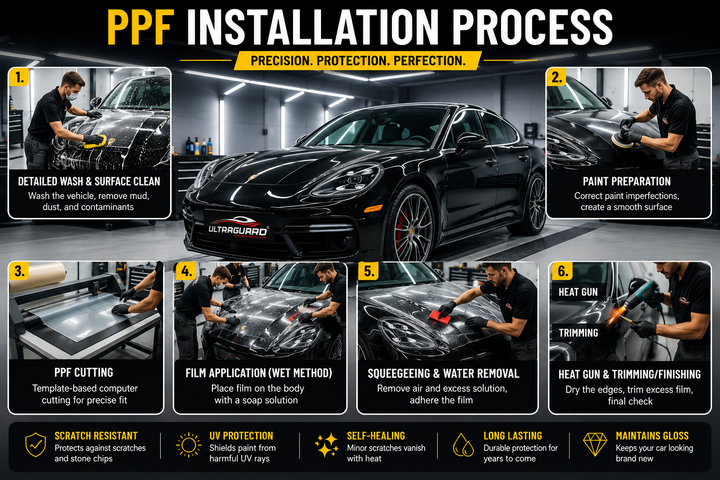
Step 1: Car Inspection
Experts first check your Car thoroughly. They identify defects, contamination, chips, or areas that may need correction. It tells the installer what needs to be corrected before the film goes on. Experts check for:
-
Scratches
-
Swirl marks
-
Edge issues
-
Rock chips
-
Repainted panels
-
Previous coatings
Step 2: Cleaning the Car
Before film application, the surface must be free of dust, grease, and contaminants. Even a tiny particle can compromise the film finish. Detail Empire starts with hard water removal. Underbody wash, tyre cleaning, engine degreasing, and foam wash follow. And the vital step: our 3-pH wash.
Chemicals We Use:
-
Hard Water Removal: Energo with various dilutions
-
Exterior Cleaning: Ductile (All-Purpose Cleaner)
-
3 pH Wash Shampoos: Primus (Alkaline), Purifica (Acidic), Semper (Neutral)
Step 3: Decontamination
Your car’s bodywork has a buildup of organic and inorganic dust. Washing alone cannot take these off. These contaminants are:
-
Iron fallout
-
Tar
-
Adhesive residue
-
Embedded grime
Decontamination includes these steps:
Chemical decontamination:
To remove the metallic impurities, we use Sidero chemical. It turns red from transparent and takes off the dust with it.
Mechanical decontamination:
The remaining bonded decontamination is then removed with clay. Their malleable, textured structure physically lifts and traps embedded pollutants. They pull microscopic rail dust, brake dust, tree sap, and overspray from paint.
IPA (Isopropyl Alcohol) wipedown:
To remove any oil residue. Clay lubricant leaves slick leftovers. The IPA removes it so that the applicator can move on with the final inspection.
If you skip decontamination, the film can create visible specks. The adhesion wouldn’t be durable.
Step 4: Paint Correction (If Required)
It contains two main steps to level out the foremost coat of OEM paint:
Compounding
It’s like scrubbing. The heavy-duty remodeling. It removes deep scratches, heavy swirl marks, and oxidation. It levels down the clear coat of your factory paint. But it leaves a hazy look.
Polishing
This is the second step that removes the haziness left by the previous process. We pair a fine polish to smooth out the microscopic marks from the compound. After polishing, we do an IPA wipeout again.
What Chemicals We Use
For the compounding process, we have a range of abrasive compounds that have different grain sizes to give a light to heavy cut. We use Liale (soft cut), Versatile (medium cut), and Audache (supreme cut) with yellow or purple wool pad. We pair it with Zentool Rotary Polisher. For polishing, we use a black HDO pad, Venere polish, and Dual Action Polisher by Zentool.
Does Every Car Need These Steps?
No, Not always. Once, a customer came with their Mercedes-Benz S-Class, straight from the showroom. It didn’t have any defects. The heavy compounding wasn’t needed. But the catch? Many detailers would skip the polishing also. But at Detail Empire, we understand that even if the car does not have any defects, it still has lived a long life before reaching you. That’s why we do a light polishing on these cars to remove micro scratches and transport spots, if any. But compounding? No, it’s not needed.
Step 05: PPF Measurement and Cutting
Once the paint is mathematically clean and bare, you move straight into film preparation. Installer lays a sheet over the panel. They would measure it and hand-trim it with some extra sheet. The film is cut with a professional blade.
NOTE: A professional detailing studio often disassembles some of the parts to make the PPF installation process seamless and perfect. These parts are: Car logos, tail light, bumper, handle, and roof rail.
Step 06: Paint Protection Film Application
Once the sheet has been cut, the applicator uses slip and tack solution to apply the film. The surface needs to be lubricated before film application. It’s important because you don’t want your PPF to instantly stick to the paint. You need to make sure to slide, position, and smooth out the film.
After spraying the slip chemical, experts align the film. Once it’s perfectly fitted, they use a hard squeegee to push all the soapy lubrication out.
What Chemicals We Use
Our dedicated range includes SlipOn PPF Gel. The gel-based formula avoids silvering, stretch marks, premature tack, and trapped debris.
Step 07: Inspection and Trimming
Once you have applied the film, check for bubbles. Flatten them out with a squeeze. Now trim the edges, and let the film cure. Then, to lock the edges, you need a tack solution that is sprayed under the edges. It flushes out the soap and activates the adhesive so that it can glue permanently. Here, we have completed the physical PPF application process.
Expert Intake:
Once you lubricate the surface and apply the film, you cannot lock the edges instantly. The film must be cured onto the surface before locking in the edges. You must wait for 4 to 5 hours. Now, you’re good to go for locking.
Step 08: The Critical Curing Phase
Now, we enter the post-heating and curing phase. If you want your edges never to peel, this is the final step. Premium TPU paint protection film has memory. It wants to snap back to its flat, un-tucked shape. You need to apply heat so that it can mold to the contours. We use a heat gun with 50°C to 60°C. Then we impose a complete lockdown on your car for almost 48 hours. No washing, no driving. You will notice water blisters which are completely natural. Do not touch them. After two days, you can drive your four-wheeled baby. But you need to avoid water on your car for 7 days.
NOTE: Color PPF installation process follows the same steps.
Now let’s answer a few common questions regarding the process:
How long does it take to install paint protection film?
A full body car PPF coating usually takes 12-13 hours. But the time varies depending on the car size, curve complexity, and rush in the studio. Detailing shops often quote 3-5 business days because one PPF applicator cannot work continuously for 12 hours. But if you are opting for partial coverage, the time would depend on how long it takes to apply paint protection film
-
Partial front PPF: 4-8 hours
-
Full front end: 6-8 hours
Is PPF hard to install?
Yes, Paint protection film installation is hard and demanding. You need a completely dust-free environment and professional tools. And on top of that, patience. Even one wrong stretch or shaping can make it all go in vain.
Who is a paint protection film technician?
A paint protection film technician is a PPF installer who has been trained and certified for PPF application. They undergo a training program to comprehend the steps, processes and chemicals used.
Can You DIY paint protection film?
Not recommended. By now, you must have understood that it's a difficult job. A DIY application cannot ensure a smooth paint correction, a dust-free environment, professional tools availability, and the professional training. The warranty also plays an important role. DIY PPF installation cannot provide a manufacturer and installer warranty. It’s best to consider a professional detailer if you want paint protection for your car.
How Much Does PPF Installation Cost in UAE?
PPF installation cost depends on a number of factors. Car size, TPU quality, installer experience, and warranties decide the exact cost you pay. Here we have listed PPF installation charges:
|
Coverage |
UAE Price |
|
Partial Front |
AED 1,500-3,000 |
|
Full Front |
AED 3,000-5,500 |
|
Full Body |
AED 7,000-15,000 |
NOTE: PPF installation on car cost can be higher for luxury Cars. It starts from around AED 20,000.
What Happens After PPF Installation?
Once PPF is cured, you need to maintain it for optimal performance. A well-maintained PPF not only lasts long but also provides unmatched protection. Our experts give a few points to take care of after your PPF installation is done:
-
Do not wash immediately after PPF curing
-
Pressure wash can lift the edges. Avoid them.
-
If you want a ceramic coating on PPF, you must wait until PPF is dry.
-
Your film’s self-healing activates with heat.
-
Always get a written warranty.
-
Give your Car a maintenance wash every 2 or 3 months.
-
Annual inspection is recommended.
What are the Common Mistakes During PPF Installation
Common PPF installation mistakes boil down to:
-
Prep
-
Alignment
-
Finishing
Our experts explain how to avoid them:
|
Mistakes |
What Happens |
Best Practice |
|
Poor surface preparation |
Dirt or dust gets trapped under the film |
Thoroughly clean and decontaminate the paint |
|
Incorrect PPF alignment |
Uneven edges and poor coverage |
Position the film carefully before fixing it in place |
|
Using little slip solution |
The film sticks too quickly and difficult to adjust |
Apply enough slip solution for positioning |
|
Overstretching the film |
The film may lose its shape or lift over time |
Stretch the film only when necessary |
|
Poor edge finishing |
Edges may peel or collect dirt |
Wrap and seal the edges properly |
|
Rushing the installation |
Lower-quality finish and durability is reduced |
Take time to install the film with precision, patience is an important tool |
Why Choose Detail Empire’s Ultraguard PPF for Professional Installation
Ultraguard is exclusively offered by Detail Empire in Sharjah and Dubai. Our flagship range is made with Lubrizol TPU, which is self-healing, resistant to stone chips and UV radiation. At Ultraguard, we believe that advanced protection comes with high-quality film and installation combined. That’s why Detail Empire is one of the best places to get PPF installation in UAE.
Our PPF applicators undergo extensive training to understand each step, with practicals included. They are certified with three levels including bronze, silver and gold. Our tools are sourced from leading global brands such as polishers and rotary machines from Zentool, pads from Lake Country, and chemicals from Labocosmetica and Maniac Line. We ensure everything from film to application quality.
Conclusion
PPF installation process cannot be a DIY project due to multiple reasons discussed before. So the bottom line? PPF is as good as the hands behind it. Paint protection film protects your paint. But the installation process protects the film. From proper surface preparation to curing, every step exists for a reason. Skipping even one can show up later as a big problem. So if you are investing in PPF, invest in the best PPF installation too.
PPF Installation Process - FAQ's
Q1. What is the installation process for PPF?
PPF application process includes cleaning the Car, decontamination, compounding, and polishing. Then the film is applied and left to cure.
Q2. How much does PPF cost in the UAE?
For a full coverage paint protection film installation, the cost is around AED 15,000.
Q3. How long does the PPF process take?
PPF process time depends on the coverage you want. A partial coverage can be done in around 4 hours, while a full front PPF can take 8 hours. A full car coverage takes around 12 hours.
Q4. What is the best place for PPF installation in Dubai?
Detail Empire is one of the best places to get PPF installation in Dubai. With 39 years of heritage in automotive care, they offer an exclusive PPF, Ultraguard. It's made with Lubrizol TPU and Ashland glue. The warranties range from 5 years to 10 years.
Q5. What’s the color PPF installation process?
Color PPF installation process is the same as the clear one. It follows cleaning, decontamination, application and curing. However, from the owner’s end, you must register the new color with RTA if you are choosing a different color from your original paint.
