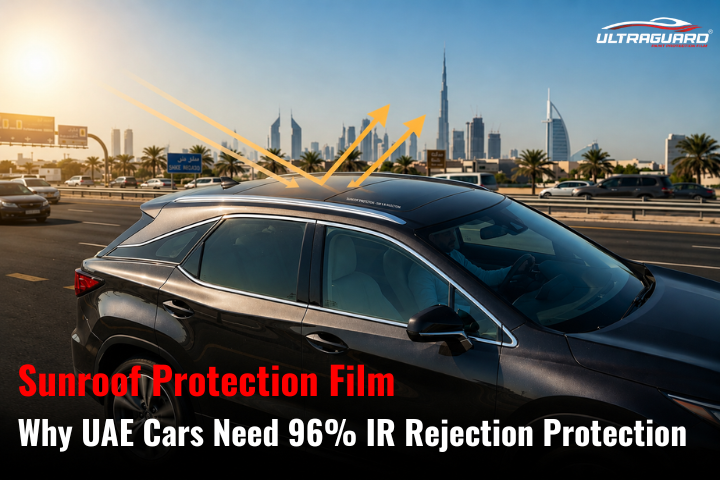
UAE cars need sunroof protection film with 96% IR (infrared) rejection because the bare sunroof lets 15% to 30% of visible light through. A sunroof is a large and horizontal glass panel that passes more solar heat and UV than side windows. Add the direct overhead radiation in the Gulf’s sun. It ultimately results in a dramatic rise in cabin temperature, load on AC and premature aging of the interiors.
Sunroof protection film (SPF) for car with 96% IR rejection can block up to 53% of solar energy. By reducing the heat gain, sunroof PPF reduces AC workload by around 40%. In this blog, we explore SPF price, marketing vs reality of “high heat rejection” and the best places to get a sunroof protection film in Dubai.
What is Sunroof Protection Film
Sunroof protection film is a multi-layer film that is applied on a car’s sunroof to control heat. It also blocks UV, reduces glare and protects from minor damage. It is especially designed for horizontal glass because it faces more exposure to heat compared to the side windows. Modern sunroof protection film, like Ultraguard, combines structural defenses of Paint Protection Film (PPF) with the heat-blocking power of ceramic tints.
How Sunroof Protection Film Works
Sunroof protection film works as an active exterior shield that rejects solar energy and protects the glass. The underlying technology can be divided into three parts:
1. TPU Core for Shock Absorption
Advanced SPFs feature a heavy-duty layer of Aliphatic Thermoplastic Polyurethane (TPU). This layer is excellent against stone chips, debris, and other impacts due to its elastic polyurethane molecular chains. They stretch momentarily and prevent energy from pinpointing on the glass. This coat also features a shape memory which gives it the self-healing quality. In the case of minor scratches from sand, the molecules shift, but when heat is applied, they automatically return to their original configuration.
2. Sputtering Solar Deflection as A Heat Gate
Another layer in sunroof protection film uses a microscopic grid with infused rare materials like silver. They reflect heat instead of absorbing it. The film reflects up to 95% of Infrared Radiation (IR) and 99% of Ultraviolet (UV) rays.
3. Structural Anchoring via Optical Adhesion
The acrylic adhesive layer is optically clear and creates a permanent bond with the glass. Due to its placement, it also holds every single micro-shard firmly in place so that the glass does not shower down on passengers.
What are the Functions of Sunroof Protection Film
-
Heat Reduction: It keeps the cabin cooler by rejecting a large amount of heat - along with 56% TSER.
-
UV Protection: Sunroof protection film blocks up to 99% of UV rays, thus protecting the interiors and passengers’ skin.
-
Reduces Glare: Diffuses piercing overhead sunlight but also depends on the VLT of the film.
-
Physical Protection: Modern sunroof films have a TPU layer that acts as a sacrificial barrier and protects from environmental damage.
How Sunroof Film Differs from Window Tints
Let’s differentiate between sunroof PPF for car and window films:
|
Feature |
Sunroof Protection Film |
Regular Window Tint |
|
Main Purpose |
Heat, UV, scratch protection |
For privacy and heat rejection |
|
Technology |
Ceramic, nano-ceramic, PPF |
Dyed, metallic, carbon, ceramic |
|
Heat Rejection |
80-96% IR rejection with high TSER |
Varies |
|
Sunroof Suitability |
Specifically designed for panoramic/laminated sunroofs |
Not all standard tints are suitable for sunroofs |
|
Appearance |
Can be clear or tinted |
darker |
|
Cost |
Higher than window tints |
Comparatively lower |
Quick Question & Answer:
Q1. Can I apply window tint on my car’s sunroof?
You should not apply window tint on your car’s sunroof because it is highly risky due to the thermal shock. Sunroof glass faces straight up at the sky. It absorbs direct solar radiation all day. Window tint can cause it to shatter or trap excessive heat. So, as automotive experts, we don’t recommend it. You should go for a sunroof protection film instead.
Q2. Can I apply PPF on my sunroof?
Well, it depends. If you have a metal sunroof, you can apply a paint protection film on it. But if it’s a glass sunroof, you should not apply PPF on it. A standard PPF applied on a glass sunroof can cause a flaky mess. It can blister and create bubbles. That’s why you should choose a glass-specific Sunroof Protection Film (SPF).
Why is Sunroof Protection Important in the UAE?
UAE has some of the world’s most intense solar radiation. If left bare, this amount of heat can cause extreme cabin heat that damages interiors, electronics wear and cracks plastic. A car parked in direct summer sun can reach 60-70°C inside. Dashboard surfaces approach 80-100°C. Why this much rise? The sunroof is the largest single horizontal glass surface in your car. It contributes disproportionately to cabin heat.
Greenhouse Effect of Sunroof Film
Sunlight passes easily through glass. It hits the seats, dash, and trim, and heats them up. That heat turns into infrared rays. But those rays can't escape back through the glass easily. So the heat gets trapped inside. This is worse in cars with glass roofs. Especially EVs with panoramic sunroofs.
Why Protection Matters More in Dubai
1. Comfort and AC Load: Gulf summers heat cabins fast. Glass roofs can hit 60°C within an hour of parking. It means more AC strain and higher energy use at startup. Sunroof film blocks 80-96% of IR and 99% of UV. So the cabin stays cooler and the AC works less.
2. Interior and Electronics Longevity: Cabin heat under a sunroof can hit 70-80°C. It can:
-
cracks dashboard plastics
-
dries out leather
-
weakens trim adhesives
Electronics near the roof face the same stress. They can fail faster from constant heat cycling.
3. UV and Health Protection: UAE UV levels stay high year-round. Unprotected glass lets much of it through. Especially on kids in the back seat under a panoramic roof. Quality panoramic sunroof protection films block up to 99% of UV-A and UV-B.
4. Glass Stress and Seal Longevity: Heating and cooling cycles stress the glass. Car sunroof protection film handles that load without adding strain, and keeps rubber seals from wearing out.
How Much Heat Can Sunroof Protection Film Block?
Sunroof protection film in the UAE can block about 96% IR heat, 99% UV, and 50-68% of total solar energy (TSER).
|
Metric |
Range |
What It Means |
|
IR Rejection |
90-96%+ |
Blocks the radiant heat you feel on skin |
|
TSER (Total Solar Energy Rejected) |
50-68% (top films reach high 60s) |
Real-world "total heat rejection" combines:
|
|
UV Rejection |
99% |
Blocks UV-A/UV-B |
|
VLT (Visible Light Transmission) |
35-70% |
Keeps the roof bright while still cutting heat |
What are the Key Metrics You Should Know: IR, TSER, UV, VLT
A customer must be aware of these to make an informed decision:
1. IR Rejection (Infrared Rejection)
-
What it is: the heat you feel
-
What it does: blocks that heat - "96% IR rejection" = 96% of that heat is stopped
-
Limitation: IR is only part of the solar spectrum. So a high IR number doesn't mean 96% of all heat is blocked
2. TSER (Total Solar Energy Rejected)
-
What it is: the real total-heat number- UV + visible light + IR combined
-
Why it matters: the most honest measure of how much cooler your cabin will actually feel
-
A film with 95% IR can still land at just 40-55% TSER
-
What should be your target in UAE: 60-68% TSER
3. UV Rejection
-
What it is: percentage of UV-A and UV-B blocked
-
Why it matters: UV causes skin damage and fades dash, seats, and trim
-
Baseline to expect: 99% UV rejection (non-negotiable in UAE's climate)
4. VLT (Visible Light Transmission)
-
What it is: how much visible light passes from the glass
-
Lower VLT: darker roof
-
Higher VLT: brighter cabin
-
Range: 35-50% VLT for standard sunroofs, 50-70% for panoramic roofs
What 96% IR Rejection Really Means in Sunroof Protection Film
A well-specced sunroof film looks like:
-
IR Rejection: ~96%
-
TSER: ~55-65%
-
UV Rejection: 99%+
-
VLT: ~50-70%
In plain terms: almost all the heat you'd feel is blocked. Total heat load drops by over half. UV protection is near-total, and the cabin stays bright - even on big panoramic roofs.
IR Rejection vs TSER: What's the Difference?
Customers often confuse these two. Let’s understand the factors:
|
Aspects |
IR Rejection |
TSER |
|
What it covers |
Infrared heat only |
Full solar spectrum (UV +visible + IR) |
|
Typical range |
80-99% |
40-68% |
|
Tells you |
How much IR heat is blocked |
How much total heat is blocked |
|
Best used for |
One piece of the puzzle |
Real-world cooling comfort |
|
Misleading risk |
High, if quoted alone |
Low (more honest number) |
Sunroof Protection Film vs Sunroof Cover
Customers also ask about Sunroof Protection Cover and Panoramic sunroof cover.
|
Feature |
Sunroof Protection Film |
Sunroof Cover |
|
Heat Protection |
High |
Depends on material |
|
UV Protection |
Yes |
Depends on coverage |
|
Visibility |
Maintains glass visibility |
Can block the view |
|
Appearance |
Low-profile |
More noticeable |
|
Permanent Solution |
Yes |
Usually removable |
|
Protection |
Heat + UV + selected physical protection |
Mainly shade/cover |
How Much Does Sunroof Protection Film Cost in Dubai?
Sunroof paint protection film can cost somewhere around AED 200-1,200. The prices depend on roof size, film technology, and brand. Premium nano ceramic sunroof films can go up to AED 1200.
|
Sunroof Type |
Approx. Price (AED) |
|
Standard sunroof (Basic dyed/carbon) |
200-350 |
|
Standard sunroof (Ceramic/nano-ceramic) |
350-600 |
|
Panoramic sunroof (Ceramic/nano-ceramic) |
600-900 |
|
Panoramic sunroof (Premium high-IR) |
800-1,200 and above |
What Affects the Price of Sunroof Protection Film?
-
Film Technology: dyed < carbon < ceramic < nano‑ceramic /spectrally selective (high‑IR)
-
Roof Size and Complexity: panoramic roofs cost more due to larger area
-
Brand: Premium brands use advanced technologies, which means costly films
-
Warranty: longer warranties (7-10+ years) command higher prices.
Is Sunroof Protection Film Safe?
Sunroof protection film is safe for your car’s sunroof if the film is compatible with automotive glass. Before making a purchasing decision, you must check the adhesive quality, installation, heat resistance, and optical clarity. They should be fully radio and satellite-signal-friendly. This can be the safest aftermarket protection film if you choose a dedicated car sunroof protection film.
Is Sunroof Protection Film Legal in the UAE?
Yes. Sunroof protection film for cars in UAE is legal. These films do not affect the driver’s visibility and safety. UAE tinting laws focus on windshields and windows. Sunroof rules remain flexible as long as the view is not very dark. But the film should not be reflective or mirror‑type. So, when a customer asks what the RTO rules are for sun films? It should not be very dark.
Where to Get Sunroof Protection Film in Dubai?
If you are searching for sunroof protection film near me, sunroof protection film Dubai or sunroof protection film UAE, you must understand how to shortlist them. The best places to get sunroof protection film in Dubai are Detail Empire, WRP Detailing Studio, ASV Phantom, Apex Detail Studio and Detailing Concept. These are premium studios offering sunroof protection film in Al Quoz, Al Qusais, Ras Al Khor, and similar industrial areas.
Ultraguard’s Sunroof Protection Film Offers 60%+ TSER
Ultraguard’s sunroof protection film offers 96% IR rejection and 99% UV rejection. It results in more than 60% TSER combined with a wide range of VLT options. It is backed by 39 years of heritage of the Manmachine Group. Here are some specifications:
-
Sunroof PPF thickness is around 190 microns
-
The film has a temperature resistance of -40°~120°C
-
The warranty period is 8 years
-
Ultraguard’s sunroof protection film has a TPU core that absorbs shock
-
It also features a self-healing TPU
Conclusion
UAE's brutal sun makes sunroof protection film a necessity, not a luxury. It has 96% IR rejection. 99% UV protection. 60%+ TSER. Sunroof film keeps your cabin cooler, protects interiors, and safeguards your health. Ultraguard's sunroof protection film combines proven ceramic technology with an 8-year warranty and 39 years of brand heritage. It's a smart, lasting investment for Dubai drivers.
FAQ's - Sunroof Protection Film for Car
Q1: How much does sunroof protection film cost?
Sunroof protection film costs start from AED 200. It reached to AED 1,200. The prices depend on roof size and complexity.
Q2: Is it safe to put film on a sunroof?
Yes, As long as you choose a dedicated sunroof protection film, it’s completely safe on your sunroof glass.
Q3: How to protect a sunroof from damage?
To protect a sunroof from damage, you can apply a high-grade sunroof protection film. This glass is very sensitive. Providing a physical barrier to this glass keeps it safe from daily wear.
Q4: What are the RTO rules for sun films?
RTO rules for sun films are flexible. The RTO rules focus mainly on windshields and windows.
Q5: Can I use sunroof film on a panoramic sunroof?
Yes, You can apply sunroof protection film on a panoramic sunroof. For this, you should choose a dedicated glass film that offers high TSER with medium VLT.
