Environmental factors matter a lot when you are driving. Why is that so? If we talk about the road conditions in the UAE and elsewhere, the intense heat exposure directly to the surface, sand, dust, road debris, and highways are some of the major factors that affect the original paint of the car. Which raise a question: will PPF help, and should I do a full car PPF or partial coverage? Which one will be better for your car? To understand which one suits your car, you have to first understand the difference between the two and how they work. In this blog, you will learn the major difference and figure out which one you should use.
What is PPF and why does your car need it in the UAE?
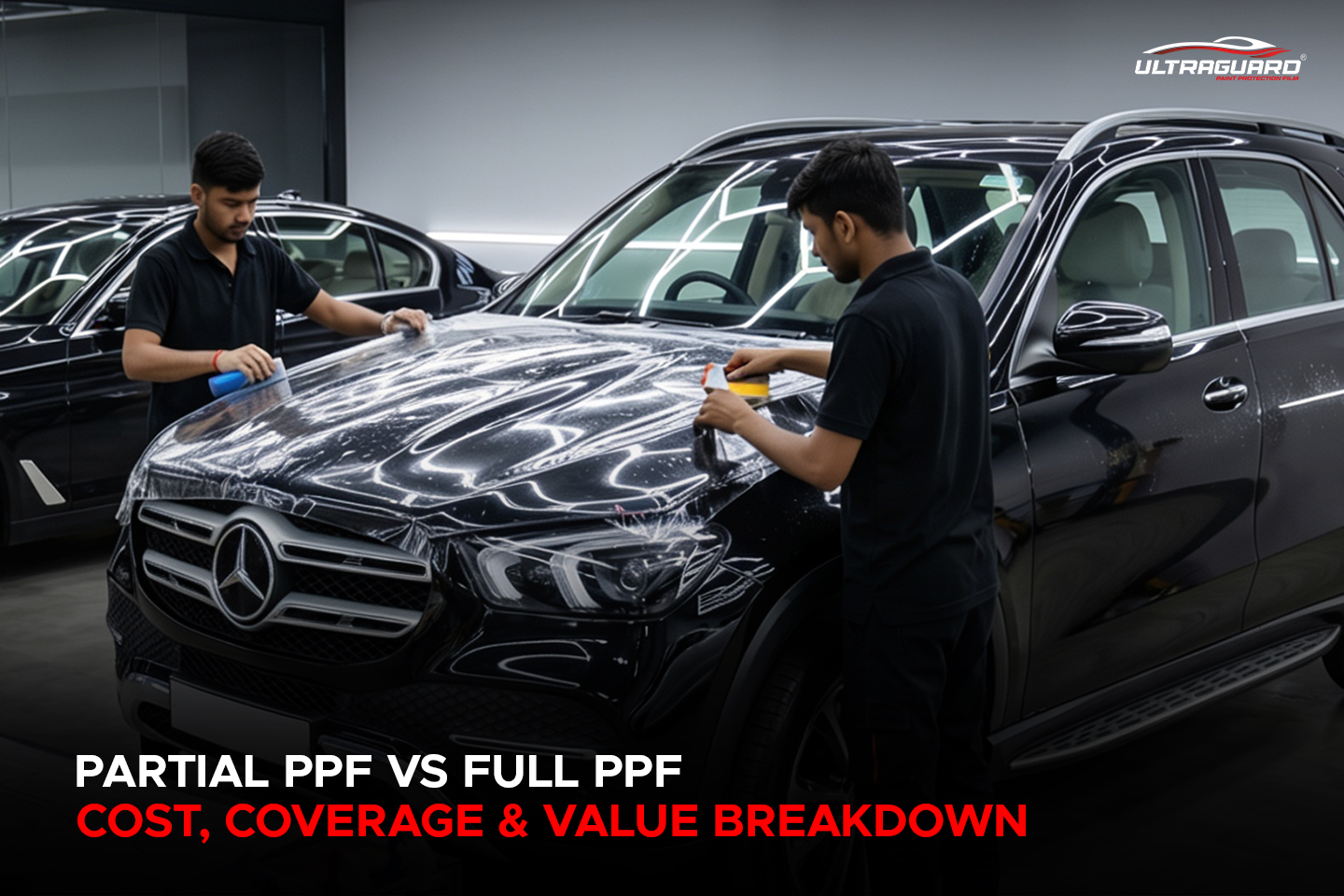
Paint Protection Film, known as PPF, is a transparent protective layer that is installed over the vehicle's painted surface. Its main purpose is to protect your car’s paint from everyday use and environmental causes that may cause damage.
Think of it like you are driving daily to your office or anywhere else, and sand can hit the lower panels, and small stones and road debris can hit the bumper of the car, which can cause damage to the car’s paint, and these scratches also look very unpleasant.
So how would PPF work? A high-quality PPF is made up of high-grade TPU and is specially designed for demanding Middle Eastern conditions. The film acts as a barrier against road debris, scratches, sand pitting, harsh UV rays, and other common factors. A very high-quality PPF includes a self-healing option, which is specifically designed to reduce scratches and swirl marks on its own when exposed to heat.
But the PPF does not guarantee that it will protect against every kind of damage. A major impact, deep cut, or any kind of serious accident can damage the film and the surface. Its real purpose is to secure your car from any external damage.
What is Full Car PPF?
A full car PPF means covering the exterior painted area of the car instead of protecting only the selected area; it protects the exterior area.
The exterior vehicle package includes:
-
Front Bumper
-
Bonnet and hood
-
Front and rear fenders
-
Doors
-
Side Pannel
-
Mirror caps
-
Rear bumper
-
Boot and tailgate
-
Roof
-
Any other painted surface
Take it as a Scenario: You are driving from Dubai to Abu Dhabi several times a week. There is a high chance that your front bumper, doors, side panels and mirror and rear sections receive scratches from road debris or may get exposed to dust, sand, and other marks from daily usage, but dosen’t mean that you cannot use the vehicle; you can just protect it with full car PPF that acts as a barrier between the conditions and protect your original paint of the car.
What is Partial PPF?
The partial coverage focuses mainly on the areas where the most affected and gets covered with PPF protection. These are the areas that the partial PPF package includes:
-
Front bumper
-
Partial or full bumper
-
Front fenders
-
Side mirrors
-
Headlights
-
Rocker panels
-
Door edges
-
Door handle area
This combination may change according to the needs of the vehicle and the owner's choice. Partial protection is the best option for someone who mainly drives within the city and wants to protect the vehicle without paying a high amount for the full exterior body.
For example: If you use your car only for short trips and rarely take the long highways for your journey, protecting the bumper, bonnet, and mirror than this is the best option for you. Without paying a lot, you can still protect your car.
Full Car PPF vs Partial Coverage: What is the difference?
The main difference is not about the protection; it’s about how your car receives it. Let’s clear this doubt and understand it with the help of a table.
|
Factor |
Full Car PPF |
Partial Coverage |
|
Coverage |
Covers the painted area |
On the high- risk areas only |
|
Initial Cost |
Higher |
Lower |
|
Front-end protection |
Excellent |
Excellent |
|
Side panel protection |
Included |
Limited |
|
Parking scratch protection |
Broader |
Depends on the selected panel |
|
Highway driving |
Very suitable |
Suitable with strong front coverage |
|
Long-term ownership |
Strong |
Depends on the usage |
|
Paint appearance |
Consistent |
May vary based on the area |
|
Best for |
Luxury, new, and long-term vehicle |
Driving within the country and budget-conscious owners |
Full Car PPF vs Partial Coverage: Which one should you choose?
The right PPF depends totally on your preferred choice, driving habits, budget, and the originality that you want to maintain for the car’s paint. Here’s a simple comparison that can help you to understand it in an easy way:
|
Consideration |
Full Car PPF |
Partial Coverage |
|
New car |
Best if you want to protect the car’s original paint from external damage and is best especially for luxury cars. |
Can be good if you want to protect your car’s most exposed areas. |
|
Regular driving |
Ideal for drivers who drive for a long time and whose car has to face more of the external environment. |
Install it if your major concern is to protect the front bumper, bonnet, and mirrors. |
|
Luxury or performance car |
Strong choice when you want to preserve the originality of the vehicle |
Suits when you want to protect the vehicle paint but only on the exposed area |
|
Long-term ownership |
Protects the overall painted surface of the car |
Good for you if you ever plan to sell your car in future |
|
City driving |
Useful for you if you are driving most of the time |
Useful for you if you are driving within the city only |
|
Budget |
Higher in cost and can be dependent on the film |
More affordable and protects the installed area |
|
Main concern |
Best if you want full external protection |
Best if you want protection from stone chips and only on the majorly exposed area |
|
Cost |
AED 7,000–13,000 for full-body protection. |
AED 1,500–3,000 for partial coverage. |
NOTE: The prices may vary based on the vehicle condition, size, and the film quality you choose.
Want to know more about how PPF is actually installed? Read this: PPF Installation Process
What makes Paint Protection Film suitable for UAE roads?
There are several conditions that make the PPF suitable for the UAE roads. Here are some of the pointers that can help you to understand:
-
Built for harsh conditions: PPF is designed in such a way that it can resist all kinds of external damage and environmental conditions, making it a major factor in the UAE, where cars are mainly exposed to heat, UV rays, sand, dust, and road debris.
-
Various options available: PPF comes in different options, including clear gloss, matte, self- healing, coloured, and textured forms, so that the owner can choose it based on their preferred choice.
-
Different protection levels: PPF is available in different thickness levels and warranty options, which allows you to choose a film that is based on your vehicle's needs.
-
Computer-cut Installation: A professional installer always makes sure that the PPF is cut in a proper manner, and for that they take the help of computer-cut technology and a digital vehicle template that help the professional to perfectly cut the film according to the vehicle's exact shape.
-
Better fit and Installation: If the pre-cut is completely and properly installed, making it easier for the professionals to properly install it.
Does installation matter as much as the film?
You cannot cook food without preparing the ingredients; just like that, preparation is very important. The same goes with the PPF; even a premium film needs proper preparation and installation:
-
Washing and decontamination
-
Clay bar treatment
-
Paint polishing and correction whenever required
-
Computer-cut film preparation
-
Film installation
-
Curing
-
Final inspection
All these steps are very important to create a smooth and clean surface before the film is applied; this helps the film to bond easily with the surface and reduces the chances of imperfections.
Which option is better for different UAE drivers?
Till now, you have learned about full car PPF and partial car PPF, but based on your requirements, you can choose any one of them:
Choose full car PPF if you have:
-
Luxury or premium car
-
Have to drive daily and have a long route
-
Drive on highways
-
Plan to keep your car for several years
-
Want to protect your exterior surface
-
Want to preserve the original paint of the car
Choose partial PPF on car if you have:
-
Drive mainly in the city
-
Go less to the highways
-
Major concern is stone chips
-
Have a lower cost
-
You are planning to sell your car in the future
-
Wants to protect your car’s front and more exposed parts only
Conclusion
The choice between the full car PPF and the partial coverage depends on your choice and how much protection you want for your car.
If you drive more on highways, park your car outside, and have long- term ownership, then the full PPF with wider coverage can be a better option for you. And if you mainly drive within the city and just want to protect the most exposed part of the car, then the partial coverage is the best option for you.
Choosing a high-quality film and professional installation matters a lot to make the surface look good with proper protection. With the proper and right approach, you can protect your car’s original paint and can keep a longer life of your car.
FAQs - Partial PPF on Car vs Full PPF on Car
Q1. Which one is a better option: a full car PPF or partial car PPF?
Full car PPF covers the full painted area of the car, while partial coverage focuses more on the area where the risk is high for the paint to get removed and get scratched.
Q2. How much does PPF cost in the UAE?
The cost depends on the vehicle, film quality, and coverage. The best quality film offered by Ultraguard ranges from AED 1500- 3000 for partial coverage, while the full front end protection is around AED 7000-13000 and may vary based on the area of the vehicle.
Q3. How long does a PPF last in the UAE?
The lifespan of the film totally depends on the quality of the film, installation, maintenance, and driving conditions. Different PPFs come with different warranty periods that can last for years depending on the product.
Q4. Can PPF protect a car from UAE heat?
Yes, a high-quality PPF is designed in such a way that it can protect the surface from heat and UV exposure. The films in the Middle Eastern conditions are properly designed to protect it from yellowing, fading, and any other environmental conditions.
